When a Pine Is Too Close to Your House: Signs It Should Come Down
Most pines near a house are fine, but a few warning signs mean it's time to have someone look up the trunk.
October 12, 2026 · 4 min read
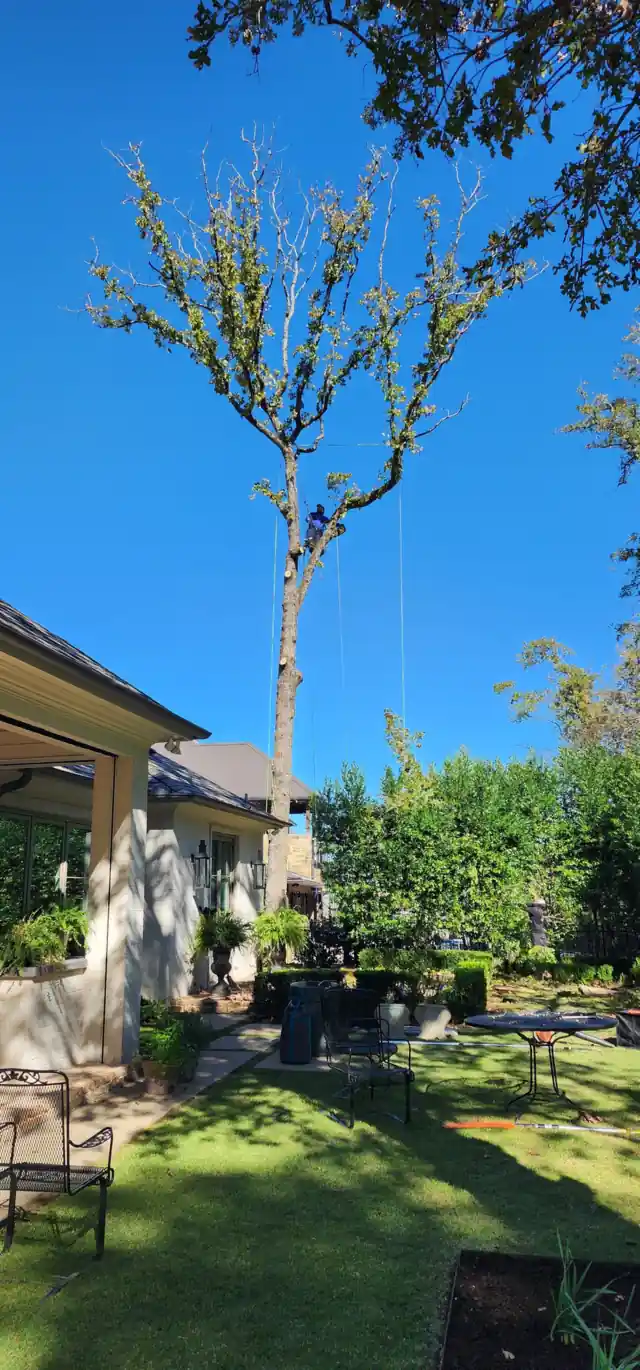
Pines grow fast in East Texas, and plenty of them were planted, or simply left standing, when the house was built. Thirty years on, a tree that once meant shade can be 80 feet tall and leaning a little toward the roof. Most of the time that's fine. Sometimes it isn't, and the goal is to find out which before a thunderstorm decides for you.
Nobody can judge a tree from a blog post. Someone has to stand under it and look up. But there are a handful of things you can spot from the yard, and they're worth knowing.
A lean that's new or getting worse
Lots of trees lean. A pine that grew up crowded by other pines often tilts toward the light and stays that way for decades without trouble. What matters is change. If the trunk seems to lean more than it did last year, or the tilt showed up after a long wet spell or a windstorm, take it seriously.
Walk around to the side opposite the lean and look at the ground. A tree that's slowly tipping often lifts the soil there, leaving a crescent-shaped crack or a small mound. Then look at what the tree is leaning toward. A lean over open pasture is one problem. A lean over a bedroom is another.
A dead top or bare branches
A pine with a brown, thin or bare crown while its neighbors stay green is telling you something. Drought and bark beetles both hit East Texas pines, and a tree that's dying from the top down gets brittle. Dead limbs and dead tops can drop on a calm afternoon. They don't need a storm.
Needles that turned red or brown all at once, little blobs of sticky resin on the trunk, and bark that's starting to fall away in sheets are the things people usually notice first. Seeing any of them on a tree within falling distance of the house is a good reason to get it looked at soon.
Roots that are lifting
Roots show how well a tree is anchored. Soil heaved up near the base, new gaps between the trunk and the ground, or roots that have broken the surface and look torn or rotten all point to a tree that isn't holding on the way it used to. Soft ground after heavy rain makes it worse, and Tyler and Chandler get plenty of that.
Cracks, splits and storm damage
A vertical crack in the trunk, a big limb split at the fork, or a broken branch hung up in the crown after a storm can all fail later, even if the tree looks fine today. Trees that took a hit in one storm are often the ones that come down in the next. Take a few photos now so you can compare them in a few months.
How a removal in sections works
When a pine stands close to a house, a fence or power lines, it usually can't just be cut at the base and dropped, because there's no safe place for it to land. So the crew takes it apart from the top down. A climber works up the tree and removes it piece by piece, with the weight controlled on ropes so nothing swings into the roof. On the ground, a track loader with a grapple can lift and move the heavy sections, and a chipper deals with the limbs.
It's slow, careful work, and it's why a big tree near a structure takes longer than most people expect. Taylor Heaton wrote that Jesus and his crew removed three very large pines and their stumps from the front yard, one of them 80 feet tall, and spent four days on the job, which also included planting two trees and prepping the yard for grass. Jill Wolverton wrote that Jesus "was able to work safely to take down a tree next to power and cable lines."
Why waiting tends to cost more
A removal you schedule is a calm job. A removal after the tree has already landed on the roof or the fence is a different kind of day, and the repair bill is on top of it. If a tree has two or three of the signs above and it's within reach of something you care about, getting an opinion costs you a phone call, and the estimate is free.
What to do before you call
- Take photos of the whole tree, the base and anything that worries you, from a few angles.
- Note what's underneath: roof, fence, driveway, power lines, a neighbor's yard.
- Keep kids, cars and pets out from under the tree until someone has looked at it.
- If a limb or the trunk is touching or close to a power line, stay well away and call the utility first.
Then give Jesus a call at (903) 952-7502. He'll come out to your place around Tyler or Chandler, look at the tree and give you a free estimate.
JR Tree Service, (903) 952-7502
Call (903) 952-7502More articles
Grind the Stump or Leave It? What East Texas Homeowners Should Know
Grinding isn't always necessary, but in most yards a stump causes more trouble than it's worth.
Trimming Oaks and Pines Around Tyler: Mistletoe, Low Limbs and Summer Heat
A good trim isn't a haircut. It's a handful of specific decisions about what the tree can lose and what it can't.