Forestry Mulching vs Bulldozing: Clearing East Texas Land the Gentler Way
Mulching grinds the brush where it stands, and that changes what your land looks like a year later.
October 12, 2026 · 3 min read
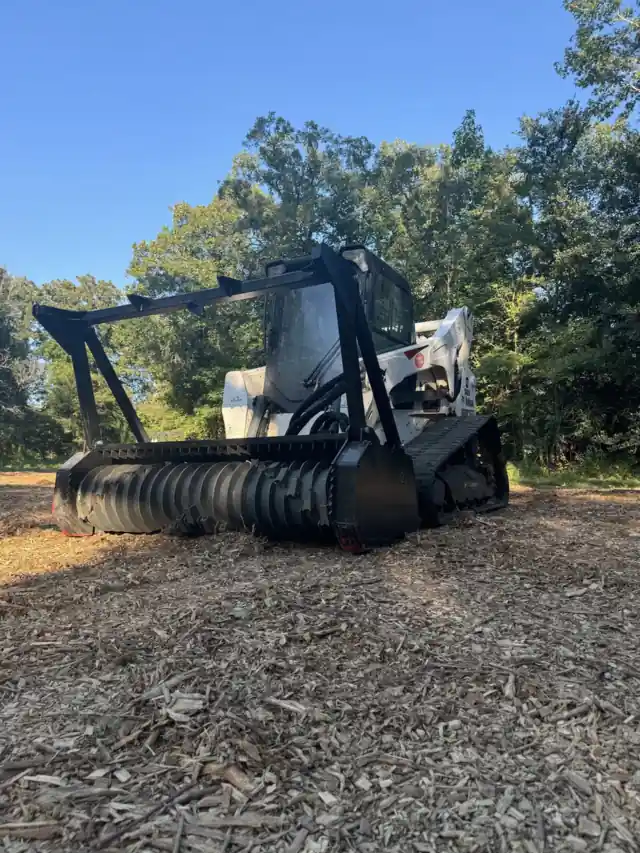
Anyone who owns a few acres in East Texas knows how fast things take over. A fence line disappears behind yaupon and briars. A pasture turns into a thicket. A lot you bought to build on sits for three years and becomes a jungle. At some point you have to decide how to get it back.
The old answer was a bulldozer. These days a lot of people ask about forestry mulching instead, and the two aren't the same thing.
What forestry mulching is
JR Tree Service describes it this way: specialized equipment grinds vegetation such as trees, shrubs and brush into mulch, which is then spread across the cleared area. In practice that means a mulcher head mounted on a track machine. It drives through the brush, and a spinning drum of teeth chews it up where it stands. Nothing gets piled and nothing gets hauled. The ground ends up covered in a layer of wood chips.
What a bulldozer does differently
A dozer pushes. It shoves trees, brush and often a good share of topsoil into piles, and then those piles have to go somewhere. Hauling takes time and trucks. Burning depends on conditions and local rules, so check with the county or fire department before you count on it. Meanwhile the scraped ground is bare, and on a slope with East Texas rain, bare ground washes away.
What mulching leaves behind
Because the roots and topsoil stay put, the mulched ground holds together better. The layer of chips protects the soil from hard rain and slows erosion. As the chips break down, they feed the ground. JR Tree Service's own description says the mulch acts as a natural organic fertilizer, replenishing nutrients and encouraging the return of native plants and wildlife. Grass and wildflowers often come back on their own once light hits the soil.
A clean, mulched lot also looks tidier. There are no brush piles to sit there for a year and shelter snakes and rats.
Where mulching is not the right tool
Mulching isn't a cure for everything, and a straight answer is more useful than a sales pitch. A mulcher cuts trees off near ground level, so stumps remain, and large ones may need a separate grinding job. If you're building a house or a driveway on the lot, you'll need a different kind of work to level and compact the ground. If you've got big hardwood timber you'd like to sell, you want that cut and milled, not ground to chips.
Some brush will also grow back. Yaupon, privet and other aggressive growers resprout from the roots. Mulching knocks them back hard and opens up the ground, but plan on keeping an eye on it for a season or two.
Choosing what stays
The best part of mulching is that the operator can work around what you want to keep. A mature oak near the pond, a stand of pines along the road, a few dogwoods: all of that can stay if you mark it first. Walk the property with the crew before work starts and flag the trees you want left standing. It's much easier to point at a tree than to describe it afterward.
Property lines matter just as much. Know where your fence lines and corners are, and tell the crew before the machine starts, not after.
The same crew can do the rest
JR Tree Service also does tree removal, trimming and stump grinding, so the big trees you want gone, the stumps and the brush can be handled together rather than coordinated across three companies. Billy Haskins wrote that Jesus and his crew did a 25-tree property in one day, and Taylor Heaton described an 80-foot pine removed along with stumps and a yard prepped for new grass. A mulching job can be the first step in the same kind of project.
What to bring to the estimate
- A rough idea of how many acres you want cleared and how thick the growth is.
- A list of the trees and features you want left alone.
- Where your property boundaries and fence lines run.
- What you plan to do with the land afterward: pasture, build, hunt or just clean it up.
If you've got overgrown acreage near Tyler or Chandler, call Jesus at (903) 952-7502 and set up a free estimate.
JR Tree Service, (903) 952-7502
Call (903) 952-7502More articles
When a Pine Is Too Close to Your House: Signs It Should Come Down
Most pines near a house are fine, but a few warning signs mean it's time to have someone look up the trunk.
Grind the Stump or Leave It? What East Texas Homeowners Should Know
Grinding isn't always necessary, but in most yards a stump causes more trouble than it's worth.